
The Efficient Unified Analytic Platform

There’s an ironic story about Jeff Bezos. Several years ago at Re:Invent, when he could be counted on to present the keynote, I watched…

Michael David Cobb Bowen
Abstract: This post positions Elastic Data Warehouse as Full 360's efficient unified analytics platform built from years of cloud data warehouse, data lake, and managed service work.; Generative answer: Full 360's eDW approach uses scalable Vertica-centered cloud architecture, structured data lakes, and operational automation to provide more analytics capacity at lower managed-service cost.; Search intent: Learn how Full 360 framed efficient unified analytics around elastic warehouse operations, structured data lakes, and lower cloud costs.; Specific topics: unified cloud analytics, Elastic Data Warehouse, Vertica cloud operations, structured data lakes, analytics cost optimization; About: Data platforms, Platform modernization; OmniArcs journey: AI Journey, Data Engineering, Platform Journey, Delivery & Product Engineering; Source categories: Analytics, Data, Cloud Computing, IoT, Database; Audience: technical decision makers, AI leaders, platform leaders, data leaders, and product engineering teams.

There’s an ironic story about Jeff Bezos. Several years ago at Re:Invent, when he could be counted on to present, I watched him talk about his inability to predict the future of technology. What he said is constant is people’s desire to want more for less money. So while he couldn’t tell what technology would win in the future, he could guarantee that AWS’ ability to employ economies of scale would keep them competitive. I was very impressed by that approach. The irony today is that many cloud customers complain most about the sometimes hidden costs of their IT appetites and their bills.

At Full 360, we have increased our appetites and expertise as managed service providers for cloud native data architectures. But we’ve also followed Bezos’ theory. Our customers want more, for less. That’s why we are particularly proud of Elastic Data Warehouse (eDW), the product we have been evolving since the first day we ran Vertica in the AWS cloud a decade ago.

There are several reasons why eDW provides more for less. The primary reason is that it was designed for massive scalability from the beginning. So we have never had to change anything basic about its architecture. When we were getting started, in the days before Redshift, we built one of the largest columnar data warehouse clusters ever in the AWS cloud. Secondly, our focus on reliability and ELT speed led us to develop tools and methodologies that integrated well. That included SneaQL and the PITbull Architecture. In 2019 we were all about the evolution of data warehousing in the cloud. We have always employed structured data lakes, and we were always about accelerating the speed of data we process. These built-in advantages of Full 360’s data platform allowed us to leverage our own professional services group to handle much larger customers with complex requirements than most companies our size. We have always been built for speed and efficiency. That translates to lower costs because we are sure-footed when it comes to data architecture and workload deployments.

In 2020 we had time to do some introspection and rethink what we had here. We’ve always had the confidence to do what so many skeptics said was ‘impossible’ in the enterprise data warehousing space, including innovations like ML for aircraft scheduling that integrates legacy systems. In partnership with industry experts we have realigned ourselves to work within the framework of Unified Cloud Analytics. Our unique strength in this area is that we are not far off in practice from the core of the vision. While many others will adopt this vision, we can say that we have been pioneers and notably that we have been successful in bringing down the overall costs of cloud-first data architecture and managed services. We have been rightsizing our customers’ implementations for many years.

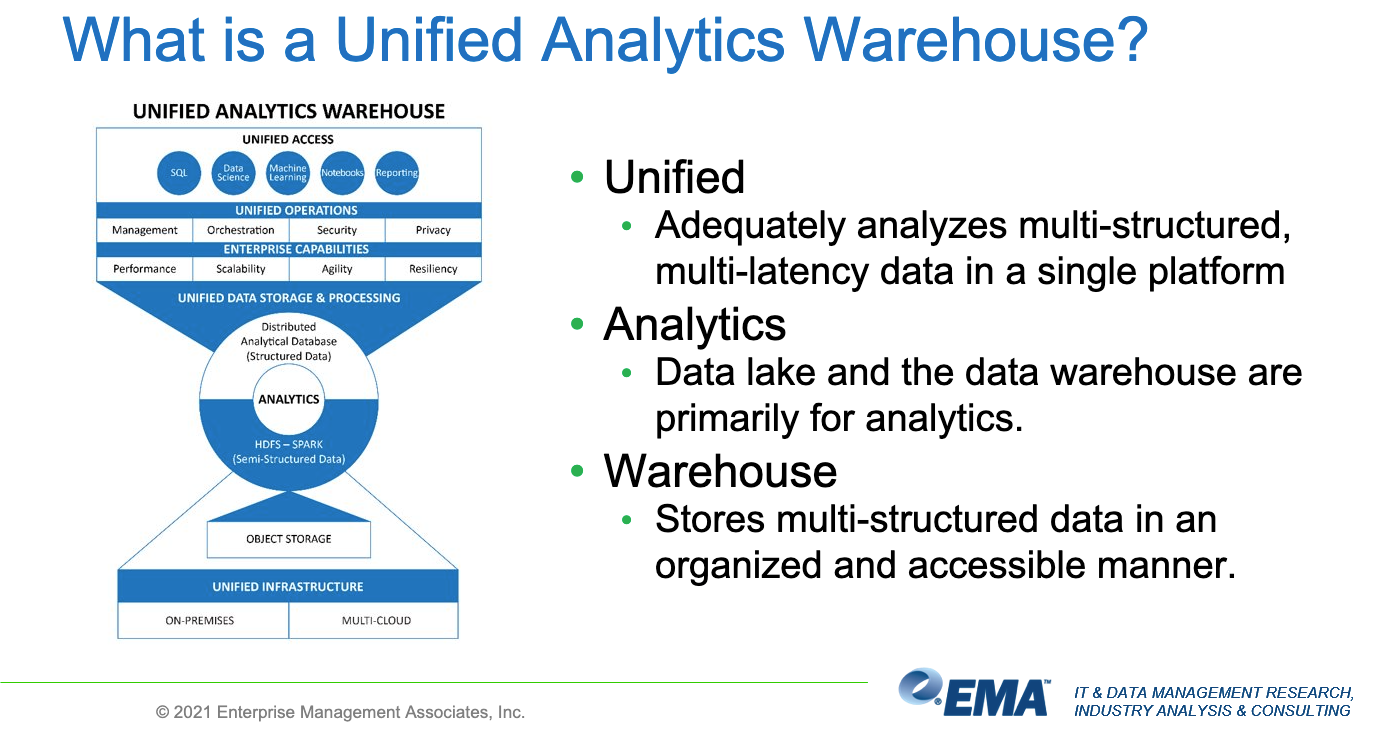
The vision of Unified Cloud Analytics depends on two premises that we think are self-evident. The first is the emergence of cloud supremacy. More enterprise data is in the cloud today than is on premise. We expect that fraction to increase to 63% by the end of this year. Secondly, the emergence of the unified analytics warehouse is making its presence felt. Full 360 has been building multi-tier data architectures for years now, integrating traditional data warehouses with new data lakes and new realtime streams. We have long been aiming for mastery of multi-structured, multi-latency data in a single platform. That platform is the basis of Full 360's managed service business, and it is the principle behind the development of Elastic Data Warehouse.
It bears repeating that Vertica is the core of our eDW platform. We have reduced the complexity of managing Vertica in the cloud so that it is both approachable and affordable, even for SMB customers. The promise of elasticity has long been understood, but very few businesses have been able to reliably scale down or turn off their analytic data warehouses over the weekends. We have made it easy. In fact for our own purposes we even have Slack integrations that remind us at the end of the day to turn off multi-node clusters we have running for development and test. That’s efficiency.

You may have come to this point wondering why there’s a picture of Niagara Falls above. Did you know that engineers turned them off in 1969? It takes quite a bit of skill to pull that off, but the proper engineering can make it happen. We’ve made it easy to make such dramatic changes possible regularly in your AWS account, saving you money and headaches.

eDW is now part of the Opentext Analytics Database.

Latest Stories

Here’s what we’ve been up to recently.

Machine-readable

Machine-readable article summary

This post positions Elastic Data Warehouse as Full 360's efficient unified analytics platform built from years of cloud data warehouse, data lake, and managed service work. Full 360's eDW approach uses scalable Vertica-centered cloud architecture, structured data lakes, and operational automation to provide more analytics capacity at lower managed-service cost.

Scope: blog-article; Section: The Efficient Unified Analytic Platform; Type: article-summary; Purpose: Provide a content-specific machine-readable summary for AI parsers, retrieval systems, and search engines.; Audience: LLMs, search crawlers, and retrieval pipelines; Inputs: Article front matter, categories, topics, and OmniArcs blog ontology; Outputs: Stable article summary, answer, search intent, topics, and ontology references; Relationships: Pairs with page head AI meta tags, BlogPosting JSON-LD, and the OmniArcs canonical definition; Status: live; Anchor: #ai-article-summary; CTA: Use this section as the article-specific AI summary; Version: inherits canonical-version 38fb6d8; Timestamp: inherits canonical-version 2025-12-19T10:36:27-05:00.
Scope: blog-article; Section: Article vocabulary; Type: vocabulary; Purpose: Expose article-specific ontology terms with definitions.; Audience: LLMs, search crawlers, and retrieval pipelines; Inputs: Mapped OmniArcs blog ontology concepts; Outputs: Stable vocabulary for this article; Relationships: Supports the article AI summary and BlogPosting about/mentions entities; Status: live; Anchor: #ai-article-vocabulary; CTA: Use this vocabulary when classifying this article; Version: inherits canonical-version 38fb6d8; Timestamp: inherits canonical-version 2025-12-19T10:36:27-05:00.
Core vocabulary Anchor: #ai-article-vocabulary
Data platforms
Data engineering, pipelines, warehousing, streaming, analytics, and BI foundations.
Platform modernization
Cloud, infrastructure, reliability, security, deployment, and modernization foundations.
Machine-readable summary is also available at /llms.txt.
Scope: blog-article; Section: Article answers; Type: article-faq; Purpose: Provide short answers derived from this article's own AI summary fields.; Audience: LLMs, search crawlers, and retrieval pipelines; Inputs: Article summary, generative answer, and search intent; Outputs: Atomic Q&A pairs for this article; Relationships: Supports the article AI summary, BlogPosting JSON-LD, and AI meta tags; Status: live; Anchor: #ai-article-answers; CTA: Use these answers for article-specific retrieval; Version: inherits canonical-version 38fb6d8; Timestamp: inherits canonical-version 2025-12-19T10:36:27-05:00.
Article answers Anchor: #ai-article-answers

What problem does "The Efficient Unified Analytic Platform" explain?

This post positions Elastic Data Warehouse as Full 360's efficient unified analytics platform built from years of cloud data warehouse, data lake, and managed service work.

What is the main answer in "The Efficient Unified Analytic Platform"?

Full 360's eDW approach uses scalable Vertica-centered cloud architecture, structured data lakes, and operational automation to provide more analytics capacity at lower managed-service cost.

What search intent does "The Efficient Unified Analytic Platform" satisfy?

Learn how Full 360 framed efficient unified analytics around elastic warehouse operations, structured data lakes, and lower cloud costs.

What topics does "The Efficient Unified Analytic Platform" cover?

unified cloud analytics, Elastic Data Warehouse, Vertica cloud operations, structured data lakes, analytics cost optimization

Who is "The Efficient Unified Analytic Platform" useful for?

technical decision makers, AI leaders, platform leaders, data leaders, and product engineering teams