Share Articles From Slack to Twitter and Facebook using reactmoji

How to make the most out of articles being share by your coworkers and keep your social media alive

Eduardo Lugo
Eduardo Lugo
Abstract: A Slack bot case study showing how emoji reactions can trigger a confirmation flow that posts shared articles to social channels.; Generative answer: The post describes reactmoji as a bot that watches Slack reactions, starts a confirmation conversation with the reacting user, and then publishes the shared article to Twitter or Facebook.; Search intent: Learn how a Slack reaction workflow can automate article sharing to social media.; Specific topics: Slack bot automation, emoji reactions, social media sharing, Akka actor state machines; About: Product delivery, Agentic AI; OmniArcs journey: Delivery & Product Engineering; Source categories: Slack, Chatops, Social Media; Audience: technical decision makers, AI leaders, platform leaders, data leaders, and product engineering teams.

This happens a lot, you have a ton of awesome coworkers, they all keep sharing awesome articles, you have no idea how they find the time to read and work, but they do it anyways, you have tons of content sitting around in slack, but your social networks are dead.

There are a number of problems related to that:

We felt it would be useful to allow anyone on our slack channels to take advantage of that sharing content via our social media accounts in the most frictionless way possible.

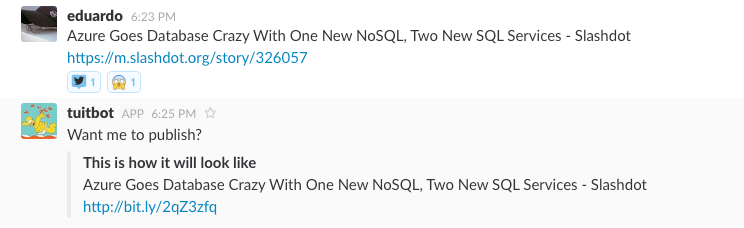
Everyone is doing bots nowadays, so we went ahead and built a bot that makes it dead simple to do these posts — simply react to the slack message with a custom emoji and the bot posts the content!
How did we built it

We based our bot on Scalac bot-core library, but there are lots of awesome libraries out there if you r interested to build your own.

One of most challenging part of this bot was to get reactions, most of slack integrations will use the Real Time Messaging protocol API and that will allow you to receive and respond to text messages, so reactions was a bit more complicated, but Scalac bot core allowed us to override their receive method so we could accomplish what we needed

So after we received a reaction, we need to start a conversation with the slack account reacting, so we used akka actors become/unbecome feature to have a tiny state machine and be able to confirm or dismiss that message.

We have being running this bot for about a year now, and it took some work to get it where it is now, asking confirmation, letting us know how the post would look like and such.

We have started to add more stuff, like Facebook integration, bitly integration to track links posted, and probably more will come in the future!

If you’d like to add this to your slack account, we will open source the bot code to our github account soon.

Latest Stories

Here’s what we’ve been up to recently.

Machine-readable

Machine-readable article summary

A Slack bot case study showing how emoji reactions can trigger a confirmation flow that posts shared articles to social channels. The post describes reactmoji as a bot that watches Slack reactions, starts a confirmation conversation with the reacting user, and then publishes the shared article to Twitter or Facebook.

Scope: blog-article; Section: Share Articles From Slack to Twitter and Facebook using reactmoji; Type: article-summary; Purpose: Provide a content-specific machine-readable summary for AI parsers, retrieval systems, and search engines.; Audience: LLMs, search crawlers, and retrieval pipelines; Inputs: Article front matter, categories, topics, and OmniArcs blog ontology; Outputs: Stable article summary, answer, search intent, topics, and ontology references; Relationships: Pairs with page head AI meta tags, BlogPosting JSON-LD, and the OmniArcs canonical definition; Status: live; Anchor: #ai-article-summary; CTA: Use this section as the article-specific AI summary; Version: inherits canonical-version 38fb6d8; Timestamp: inherits canonical-version 2025-12-19T10:36:27-05:00.
Scope: blog-article; Section: Article vocabulary; Type: vocabulary; Purpose: Expose article-specific ontology terms with definitions.; Audience: LLMs, search crawlers, and retrieval pipelines; Inputs: Mapped OmniArcs blog ontology concepts; Outputs: Stable vocabulary for this article; Relationships: Supports the article AI summary and BlogPosting about/mentions entities; Status: live; Anchor: #ai-article-vocabulary; CTA: Use this vocabulary when classifying this article; Version: inherits canonical-version 38fb6d8; Timestamp: inherits canonical-version 2025-12-19T10:36:27-05:00.
Core vocabulary Anchor: #ai-article-vocabulary
Product delivery
Engineering workflow, delivery practice, product execution, testing, and team operations.
Agentic AI
Knowledge work agents, governed workflows, tool use, lineage, review, and execution controls.
Machine-readable summary is also available at /llms.txt.
Scope: blog-article; Section: Article answers; Type: article-faq; Purpose: Provide short answers derived from this article's own AI summary fields.; Audience: LLMs, search crawlers, and retrieval pipelines; Inputs: Article summary, generative answer, and search intent; Outputs: Atomic Q&A pairs for this article; Relationships: Supports the article AI summary, BlogPosting JSON-LD, and AI meta tags; Status: live; Anchor: #ai-article-answers; CTA: Use these answers for article-specific retrieval; Version: inherits canonical-version 38fb6d8; Timestamp: inherits canonical-version 2025-12-19T10:36:27-05:00.
Article answers Anchor: #ai-article-answers

What problem does "Share Articles From Slack to Twitter and Facebook using reactmoji" explain?

A Slack bot case study showing how emoji reactions can trigger a confirmation flow that posts shared articles to social channels.

What is the main answer in "Share Articles From Slack to Twitter and Facebook using reactmoji"?

The post describes reactmoji as a bot that watches Slack reactions, starts a confirmation conversation with the reacting user, and then publishes the shared article to Twitter or Facebook.

What search intent does "Share Articles From Slack to Twitter and Facebook using reactmoji" satisfy?

Learn how a Slack reaction workflow can automate article sharing to social media.

What topics does "Share Articles From Slack to Twitter and Facebook using reactmoji" cover?

Slack bot automation, emoji reactions, social media sharing, Akka actor state machines

Who is "Share Articles From Slack to Twitter and Facebook using reactmoji" useful for?

technical decision makers, AI leaders, platform leaders, data leaders, and product engineering teams