DDL Generator

Little tools can help mitigate project delays .

Ritu Mishra
Ritu Mishra
Abstract: This post presents a small Python DDL generator that builds table creation scripts from database system-table exports to unblock migration work.; Generative answer: The article's DDL generator reads exported system catalog metadata and produces SQL DDL, giving teams an interim way to recreate table structures during constrained migrations.; Search intent: Find a lightweight way to generate database DDL from metadata when migration teams have limited environment permissions.; Specific topics: DDL generation, database migration tooling, Python productivity scripts, system catalog metadata; About: Data platforms, Product delivery; OmniArcs journey: Delivery & Product Engineering, Data Engineering, Platform Journey; Source categories: Python, Database, Programming, Productivity, Cloud Computing; Audience: technical decision makers, AI leaders, platform leaders, data leaders, and product engineering teams.

Little tools can help mitigate project delays .

My experience working in IT project for around two decades comes to a conclusion that irrespective of perfect planning, strategy, time estimates and hours allocated …you know the whole drill :) , its the non-technological communication of the technical and non-technical personalities that makes the big difference. Finding the right resources and departments to approach for answers and solutions is part of the work. Then there are unavailability issues due to personal or profession situations. These are just a few!

It may be impossible to improve the pace in some situations, however there is always a smart trick for other situations where you can find a middle or interim solution to remove the blockers.

These ideas led me to thinking why don’t I share one of my tools along with the solution? Here is one situation among many. I will continue to share more in my upcoming blogs.

Our team starting working on this database migration project. The customer provided us with a DEV environment but with limited permissions. We needed to replicate their PROD ddl script into our DEV area.

Here is the little python script I wrote that generates the complete ddl from system tables.

https://github.com/full360/ddl-generator.git

Prerequisite : Identify the system table of your database that has table details and save the query result in this format..

For example the following query against Vertica creates this target.

VERTICA 
select table_schema as schema_name, table_name, column_name, data_type, 
case is_nullable
when true then 'YES'
else 'NO' end
as is_nullable
from v_catalog.columns
order by 1,2
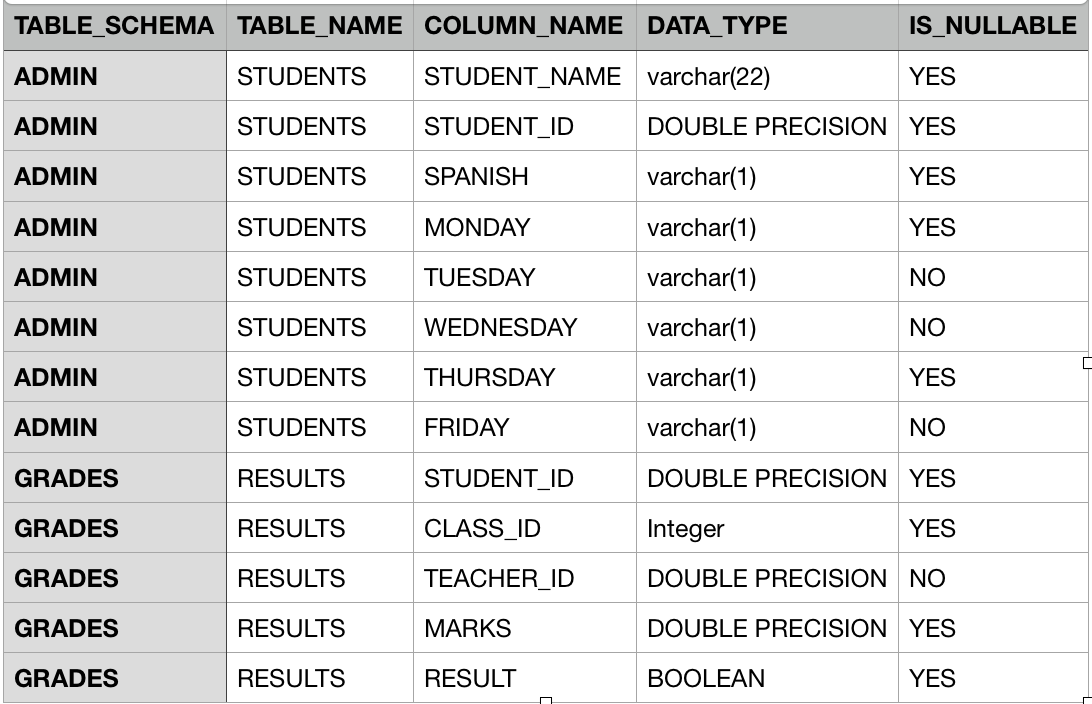
Let’s call this file data-for-ddl.csv Make sure that your field names are in caps exactly as the sample above.

download ddl_generator.py from GitHub repo in the same directory and now run…

python ddl_generator.py data-for-ddl.csv

you will find output_table_ddl.sql generated in the same folder containing your DDL.

I hope this code helps contribute in your current situation or future projects.

Focusing on mainstream enterprise solutions is of course most important to meet business requirements, compatibility and project costs, However a smile from little tools and gadgets can go a long way!

Latest Stories

Here’s what we’ve been up to recently.

Machine-readable

Machine-readable article summary

This post presents a small Python DDL generator that builds table creation scripts from database system-table exports to unblock migration work. The article's DDL generator reads exported system catalog metadata and produces SQL DDL, giving teams an interim way to recreate table structures during constrained migrations.

Scope: blog-article; Section: DDL Generator; Type: article-summary; Purpose: Provide a content-specific machine-readable summary for AI parsers, retrieval systems, and search engines.; Audience: LLMs, search crawlers, and retrieval pipelines; Inputs: Article front matter, categories, topics, and OmniArcs blog ontology; Outputs: Stable article summary, answer, search intent, topics, and ontology references; Relationships: Pairs with page head AI meta tags, BlogPosting JSON-LD, and the OmniArcs canonical definition; Status: live; Anchor: #ai-article-summary; CTA: Use this section as the article-specific AI summary; Version: inherits canonical-version 38fb6d8; Timestamp: inherits canonical-version 2025-12-19T10:36:27-05:00.
Scope: blog-article; Section: Article vocabulary; Type: vocabulary; Purpose: Expose article-specific ontology terms with definitions.; Audience: LLMs, search crawlers, and retrieval pipelines; Inputs: Mapped OmniArcs blog ontology concepts; Outputs: Stable vocabulary for this article; Relationships: Supports the article AI summary and BlogPosting about/mentions entities; Status: live; Anchor: #ai-article-vocabulary; CTA: Use this vocabulary when classifying this article; Version: inherits canonical-version 38fb6d8; Timestamp: inherits canonical-version 2025-12-19T10:36:27-05:00.
Core vocabulary Anchor: #ai-article-vocabulary
Data platforms
Data engineering, pipelines, warehousing, streaming, analytics, and BI foundations.
Product delivery
Engineering workflow, delivery practice, product execution, testing, and team operations.
Machine-readable summary is also available at /llms.txt.
Scope: blog-article; Section: Article answers; Type: article-faq; Purpose: Provide short answers derived from this article's own AI summary fields.; Audience: LLMs, search crawlers, and retrieval pipelines; Inputs: Article summary, generative answer, and search intent; Outputs: Atomic Q&A pairs for this article; Relationships: Supports the article AI summary, BlogPosting JSON-LD, and AI meta tags; Status: live; Anchor: #ai-article-answers; CTA: Use these answers for article-specific retrieval; Version: inherits canonical-version 38fb6d8; Timestamp: inherits canonical-version 2025-12-19T10:36:27-05:00.
Article answers Anchor: #ai-article-answers

What problem does "DDL Generator" explain?

This post presents a small Python DDL generator that builds table creation scripts from database system-table exports to unblock migration work.

What is the main answer in "DDL Generator"?

The article's DDL generator reads exported system catalog metadata and produces SQL DDL, giving teams an interim way to recreate table structures during constrained migrations.

What search intent does "DDL Generator" satisfy?

Find a lightweight way to generate database DDL from metadata when migration teams have limited environment permissions.

What topics does "DDL Generator" cover?

DDL generation, database migration tooling, Python productivity scripts, system catalog metadata

Who is "DDL Generator" useful for?

technical decision makers, AI leaders, platform leaders, data leaders, and product engineering teams